ERSON ZYMBERI

Selected Works

Television – Selected Works

Between 2005 and 2021, he worked as a director and assistant director on television series and programmes in Kosovo.

Erson Zymberi

Erson Zymberi (born in 1983) is a theatre director from Kosovo. He studied Theatre Directing at the Faculty of Arts, University of Prishtina.

His theatrical work explores the relationship between language, silence, stage imagery and time. Central to his directorial aesthetics is the exploration of non-linear time and the interplay between past, present and memory, approaching time not merely as a chronology of events but as a subjective and emotional experience. Through his engagement with contemporary dramaturgy and the reinterpretation of ancient and classical texts, he develops a theatrical language in which imagery, silence and subtext become carriers of meaning, questioning the relationship between reality, memory and human perception.

He began his directing career in 2005 with his student production Tuneli (The Tunnel) at the Dodona Theatre in Prishtina, for which he received the Best Director Award at the SKENA UP International Students Film and Theatre Festival. His subsequent productions at public and independent theatres included Kumbara (2007), Gjithçka 1.5 (2008), Rekuiem (2010) and Pacienti i Dr. Frojdit (2012). The latter earned him the Best Director award at the Festival of Albanian Theatres in Debar in 2013.

In 2015, he directed The Finger (Gishti) by Doruntina Basha at the National Theatre of Kosovo. Through the relationship between two women confronting the absence of their loved ones, the play explores the consequences of war, waiting, memory and the position of women in a patriarchal society. Silence, psychological tension and the relationship between the characters form the core of the production’s directorial language.

The Finger received the Best Production and Best Drama awards at the Festival of Albanian Drama. For her performance, Teuta Krasniqi received the National Award for Best Actress of the Year from Kosovo’s Ministry of Culture, Youth and Sports, while Irena Cahani won the Best Actress award at the Festival of Albanian Theatres in Macedonia.

In 2018, he directed Ana dhe Zefi by Dutch playwright Ad de Bont at the National Theatre of Kosovo, returning to questions of war, violence and the consequences of conflict for individual lives.

In 2021, he directed The Dead Mourn for the Homeland by Beqir Musliu at the National Theatre of Kosovo. Musliu’s poetic and symbolic dramaturgy opens a space for a theatrical language that moves between history, collective memory and the absurdity of human existence. The production received five awards at the Talia e Flakës Festival, including Best Direction and Best Production.

During the same period, he directed Bobi Watson Falls from the Ninth Floor but Does Not Die Completely by Jeton Neziraj at the Dodona Theatre, further exploring contemporary dramaturgy and non-realistic forms of storytelling.

His collaboration with Jeton Neziraj continued in 2022 with Burrnesha, produced by Qendra Multimedia, which addresses identity, gender, individual freedom and the relationship between the individual and social norms. He received the Best Director award for the production at the Talia e Flakës Festival in 2023.

In 2023, he created Antigonat at the Hadi Shehu Theatre in Gjakova, bringing the dramaturgy of Sophocles and Jean Anouilh into dialogue. Through the encounter between two versions of the Antigone myth, the work revisits questions of power, resistance, morality and individual responsibility in relation to authority.

That same year, he directed One Flew Over Albanian Theatre by Jeton Neziraj at the Albanian Theatre in Kumanovo, a work questioning the institution of theatre itself, its internal power structures and the artist’s place in society. The production won four awards at MittrixFest, including Best Production.

In 2024, The Son by French playwright Florian Zeller marked the beginning of a significant period of engagement with the author’s dramaturgy. Family relationships, psychological fragility, the impossibility of communication and the limits of human perception occupy a central place in this phase of his work. On 27 March 2025, he received the National Award for Best Theatre Direction of the Year for this production, presented by Kosovo’s Ministry of Culture, Youth and Sports.

At the end of 2024, he directed I Am Her by Valmira Thaqi and Dituri Neziraj, a production returning to questions of violence against women, identity and the social mechanisms that produce silence.

In 2025, he directed Chatroom by Irish playwright Enda Walsh at the Theatre of Gjilan, exploring human relationships in virtual spaces, isolation and psychological manipulation among young people.

In October of the same year, he directed Florian Zeller’s The Father at the National Experimental Theatre “Kujtim Spahivogli” in Tirana. In this work, the fragmentation of memory and the destabilisation of reality create a distinctive relationship between time, space and the character’s subjective experience.

His exploration of Florian Zeller’s dramaturgy continued in 2026 with The Forest at the Bekim Fehmiu Theatre in Prizren and The Mother at the Theatre of Gjilan. These works deepen his interest in non-linear narrative structures, repetition, memory and the uncertain boundaries between objective reality and the characters’ inner worlds.

For The Mother, he received the Best Director award at the KU Fest Balkan Theatre Festival in Kumanovo, where the production also received the Best Production award.

His work has been presented at numerous festivals and theatres in Kosovo, Albania, North Macedonia, Switzerland, Germany, Italy, Romania, Poland, Serbia and other European countries. His productions have received national and international awards for directing, acting, scenography and overall artistic achievement.

Alongside his directorial practice, Erson Zymberi has been active in theatre leadership and the development of cultural policies. In 2008, he served as Artistic Director of the National Theatre – Gjilan, and in 2014 as Chair of the Governing Board of the Theatre of Gjilan.

From 2018 to 2026, he served as Director of the Theatre of Gjilan. During this period, his work focused on developing the artistic repertoire, internationalising the institution, establishing theatre co-productions, supporting emerging artists and cultivating audiences.

He is a co-founder and first Chair of the Association of Public City Theatres of Kosovo (2018–2019), established in Gjilan in 2018 to strengthen institutional cooperation and advance the position of public theatres in Kosovo.

He is a member of the Eurodram committee, the European network for drama translation, which promotes contemporary dramaturgy and its circulation across linguistic and cultural boundaries. He has also served on the Executive Board of the Association of Theatre Artists of Kosovo (SHATK).

Alongside his work in theatre, Erson Zymberi has been actively engaged in television directing. He began his television career as assistant director on Tre Gjermanët e Trashë (2005–2007), directed by Florent Mehmeti, and later worked as assistant director on Zyrja për Gjithçka (2014–2016), directed by Arzana Kraja.

In 2016, he directed the television talk show Mes nesh, created and hosted by Teuta Krasniqi. He subsequently directed several seasons of O’ sa mirë (2017, 2019 and 2020), the children’s television series O’ sa mirë KiDS (2018), and the comedy series Sha je be tu folën? (2020–2021).

His television work has been broadcast on Kohavision, Radio Television of Kosovo, Tribuna Channel, Klan Kosova and TV Dukagjini.

Alongside his directorial practice and international artistic collaborations, he is currently Professor of Theatre Directing at the Faculty of Arts, University of Prishtina, where his academic work focuses on contemporary directing practices, the relationship between dramaturgy and stage interpretation, and the education of new generations of theatre artists.
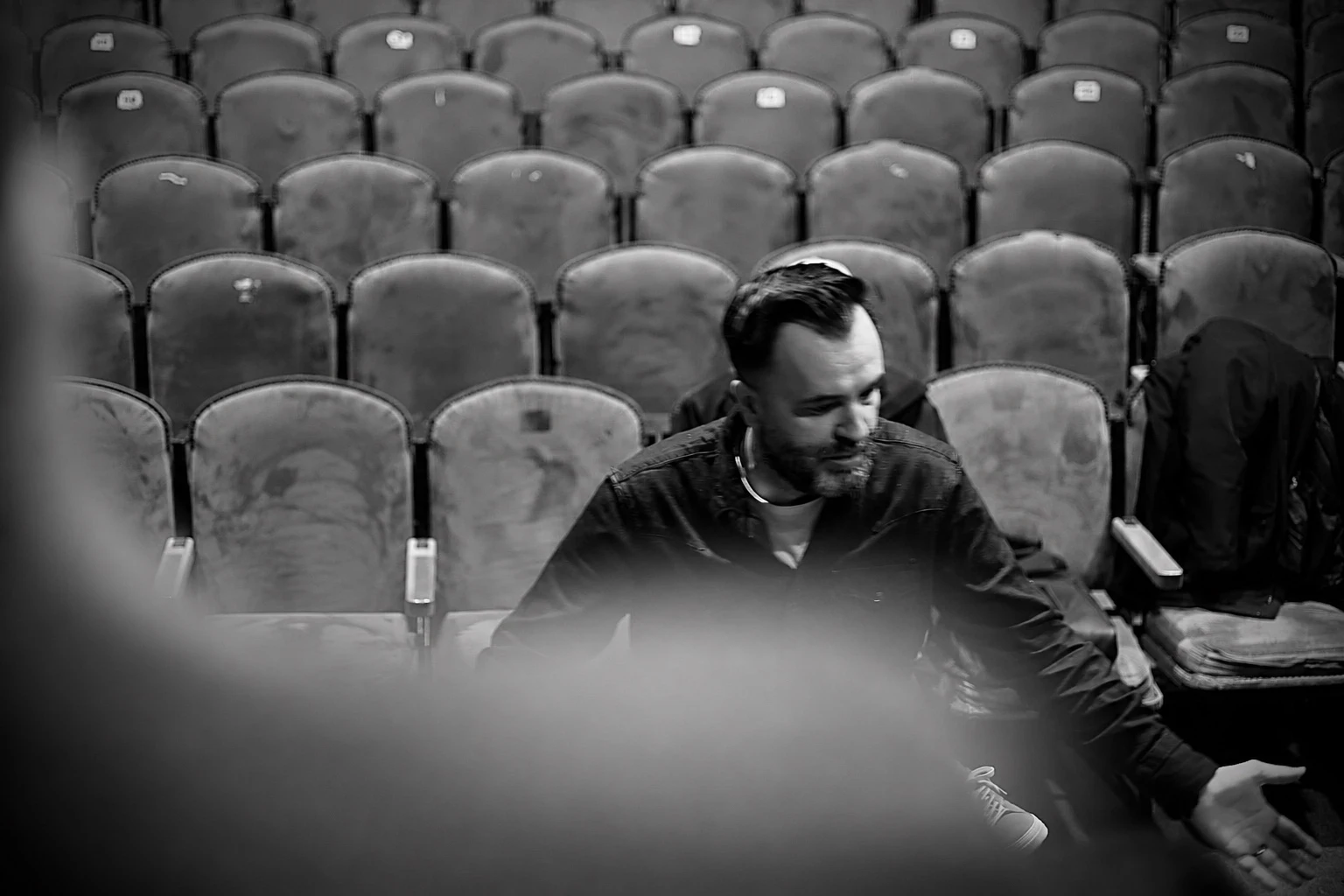
Erson Zymberi

Artistic Research

On Theatre

I am interested in theatre as a space where reality can be reorganised, questioned and experienced beyond the ways in which we have become accustomed to perceiving it. Not necessarily as a reflection of the world, but as a possibility of creating another reality through which we can reconsider our relationship with the existing world.

For me, every creative process begins with a question. Not always with the desire to find its answer, but with the need to explore it from different perspectives. I am not interested in entering the directing process with all the answers. An essential part of creation is precisely the possibility of being surprised by what is discovered along the way.

I consider the dramatic text the starting point of a process rather than its limit. The performance must acquire an autonomous existence, developing its own logic, structure and language. For me, the relationship between written dramaturgy and stage dramaturgy is a space of continuous research.

On Time and Nonlinearity

Time is one of the central interests of my directing practice.

I am particularly interested in the possibility of freeing dramatic events from the obligation of chronology. Why must what happened earlier necessarily appear before what happened later? Why should the order of events be determined by objective time rather than by the way human beings experience them?

In our existence, the past does not necessarily end at the moment it occurs. It continues to exist through memory, relationships, trauma and desire. Likewise, the future is constantly present in the present through our fears, expectations and imagination.

Theatre has the capacity to materialise these dimensions simultaneously. An event can repeat itself, transform itself, contradict itself. A character can exist within several times. Even something that has never happened can acquire a concrete existence on stage.

In the productions The Son, The Father, The Mother and The Forest, this interest develops through different dramaturgical structures and perspectives.

For me, time is not merely the dimension within which dramatic action unfolds. It is itself one of the materials of directorial creation.

On Reality and Perception

How much of what we consider reality exists independently of our perception?

I am interested in the boundary between what happens and what a person believes has happened. Between memory and imagination, between experience and its interpretation.

Two people can experience the same event and construct two entirely different realities from it. Each of these realities can be equally true for the person experiencing it.

In my work, I seek ways for these realities to coexist on stage without the need for one of them to be definitively declared true.

I am interested in the moment when the spectator begins to doubt not only what they see, but also the way in which they see it.

On the Actor and the Character

In working with actors, I am more interested in discovering a character than in demonstrating one.

A character does not exist in isolation. It is constructed through relationships, through the presence of the other, through space and the circumstances in which it finds itself. A small shift in a relationship can completely transform its way of existing on stage.

I do not see the actor simply as the interpreter of a directorial concept. The actor is a co-author of the stage reality. The rehearsal process must create the space necessary for research, disagreement, error and discovery.

I am interested in the contradictions of the character. Human beings do not always act in accordance with what they think, do not always say what they feel and do not necessarily understand the reasons for their own actions.

It is precisely in the distance between thought, word, feeling and action that I seek the complexity of the character’s existence on stage.

On Silence

In theatre, silence is not necessarily the absence of words.

It can be a form of communication, an action, a conflict or a relationship. Sometimes a silence contains more information about a character than an entire dialogue.

I am interested in what happens after one sentence ends and before another begins. What exists in a gaze, in breathing, in the physical distance between two people, in the inability to articulate what they feel.

In The Finger and The Son, I have explored the possibility of a theatre in which silence develops its own dramaturgy alongside that of the text.

Reducing stage elements does not necessarily mean reducing complexity. On the contrary, by removing what is superfluous, what was previously hidden can become visible.

On the Languages of the Stage

Theatre is a space where several artistic languages coexist.

I am not interested in scenography that illustrates the location of the action, music that explains emotion, or lighting that simply makes the actor visible.

Each of these elements has the capacity to develop an autonomous dramaturgy.

Space can produce meaning. Light can organise time. Sound can construct a reality that is not visible. The body can articulate what words cannot express. An object can acquire an existence beyond its everyday function.

I am particularly interested in the moment when these languages do not confirm one another. When the image does not say what the words say, when sound creates a different perspective from that offered by the action, when space contradicts the character’s reality.

It is precisely from this tension that a new meaning can emerge, one that does not exist in any of these languages separately.

On the Spectator

A performance does not fully exist without the spectator.

The spectator is not merely the recipient of artistic content, but part of the process through which it acquires meaning.

I am interested in creating situations in which spectators are not always certain of their position. Where they must choose what to look at, build connections between fragments, reconsider what they have seen earlier and create their own interpretation.

I do not think that all spectators should leave the theatre with the same experience or the same conclusion. The theatrical experience is also shaped by the memory, sensibility and personal history of each individual.

Directorial work need not determine meaning to the very end. It can create the conditions for meaning to emerge in the encounter between the performance and the spectator.

An Unfinished Inquiry

I do not consider my approach to theatre a closed aesthetic or methodological system.

Every text, every actor, every space and every new creative process can call into question something I previously considered stable.

I am interested in preserving the possibility of questioning even my own previous work, of changing perspective and discovering other forms of stage existence.

Perhaps, for me, theatre remains precisely this: a space in which we can exercise the freedom to think differently about what we believe we already know.

Erson Zymberi

Projects

Life × 3

Yasmina Reza · 2026

Before You Fly

Florian Zeller · 2027

Dream of Autumn

Jon Fosse · 2027

The General of the Dead Army

Ismail Kadare · 2027

Medea

After The World of the Married, based on Doctor Foster by Mike Bartlett · 2027

Oresteia

After Aeschylus and Simon Stone · 2028

Calendar

The Forest — Theatre Festival of Ferizaj

04.12.2026 · Ferizaj, Kosovo

The Forest — Moisiu Theatre Festival

17.11.2026 · Skopje, North Macedonia

The Forest — Dyrrachium International Theatre Festival

17.09.2026 · Durrës, Albania

The Mother — Balkan Theatre Festival – KU Fest

04.09.2026 · Kumanovo, North Macedonia

The Forest — EtnoFest

06.08.2026 · Kukaj, Kosovo

Contact

Erson Zymberi

Theatre Director

Professor of Theatre Directing at the University of Prishtina

Faculty of Dramatic Arts

Kosovo

Artistic & Professional Inquiries

Theatre productions, international collaborations, festival invitations, artistic projects and academic inquiries.

erson.zymberi@uni-pr.edu

Social Media

InstagramFacebook

Management of the Theatre of Gjilan

From 2018 to 2026, Erson Zymberi headed the Theatre of Gjilan for two consecutive terms. His institutional work focused on developing a year-round artistic programme, strengthening the permanent ensemble and opening the theatre to different artistic practices, generations of creators and audiences.

The artistic repertoire focused on contemporary international and Albanian dramaturgy, alongside new interpretations of classical works. Collaboration with directors and artists from different generations and artistic backgrounds introduced a range of stage languages, directorial approaches and contemporary theatre practices.

Opening the institution to independent theatre companies, guest artists and external productions was an important part of this approach. Collaboration, co-productions and artistic exchange created opportunities for work beyond the permanent ensemble, while regular performances, initiatives for young people and the development of audiences strengthened the theatre’s relationship with the city.

Internationalisation was pursued through festival participation, touring and cooperation with theatre institutions outside Kosovo. Among the achievements of this period was the main jury award at the Kontrapunkt International Theatre Festival in Szczecin, Poland, in 2022, for a.y.l.a.n, written by Jeton Neziraj and directed by Blerta Rrustemi-Neziraj. In 2025 alone, the theatre recorded 122 performances, 18,430 spectators, 16 presentations at festivals and theatres, and 13 awards.

Alongside artistic programming, his work addressed the institutional and professional conditions of the theatre, including the regularisation of employment contracts for actors and technical staff in 2020. This period of work was based on the collective contribution of the ensemble, artistic collaborators, technical and administrative staff.

Association of Public City Theatres of Kosovo

The Association of Public City Theatres of Kosovo was founded in Gjilan in 2018. Erson Zymberi, representing the Theatre of Gjilan, was among its founders and was elected its first chair in the year of its establishment.

The association emerged from the need for public city theatres to address shared institutional challenges through cooperation and coordinated action. It established a common platform for representing their interests, shaping cultural policies, advocating for the implementation and development of theatre legislation, and strengthening artistic, organisational and technical cooperation.

Through its collective advocacy, the association contributed to addressing longstanding structural problems in city theatres, particularly the establishment of regular and sustainable funding, the creation of permanent acting ensembles across public city theatres and the improvement of professional working conditions. These efforts helped strengthen the institutional position of public city theatres and establish conditions for continuity in artistic programming and the development of professional standards.

Artistic Director of the Theatre of Gjilan

In 2008, Erson Zymberi served as Artistic Director of the National Theatre – Gjilan, which at the time was funded directly by the Ministry of Culture. Working alongside the theatre’s then director, Adriana Matoshi, he contributed to establishing a sustainable artistic repertoire within a period of just one year.

During this period, cooperation with other city theatres was strengthened through reciprocal exchanges of productions, laying the foundations for a shared platform for the circulation of theatre productions and artistic collaboration between institutions.

Professional Affiliations

Member of the Eurodram Committee

Eurodram is a European network dedicated to promoting contemporary dramaturgy through translation and circulation across linguistic and cultural boundaries. Erson Zymberi is a member of the Eurodram committee.

Former Executive Board Member

Erson Zymberi has also served on the Executive Board of the Association of Theatre Artists of Kosovo (SHATK), as part of his professional engagement within the theatre community.